Top 5 Mistakes After Knee Replacement
Knee replacement recovery is rarely a straight line. A good morning can be followed by a swollen afternoon, and progress often comes in small gains rather than dramatic leaps. The biggest mistakes after knee replacement are usually not spectacular errors. They are everyday choices: doing too little, doing too much, ignoring the wound, changing medicines without advice, or assuming that pain means rehabilitation should stop completely.
After knee replacement surgery, the safest approach is to follow the plan given by your surgeon and physiotherapy team while paying attention to changes that do not feel like ordinary recovery. Current NICE guidance recommends mobilisation and rehabilitation beginning on the day of surgery where possible, or within 24 hours. The NHS also advises regular movement, prescribed exercises and gradual progression. This article explains five common mistakes after knee replacement and what to do instead.
Skipping Physiotherapy or Becoming Too Inactive
Rest matters, but complete inactivity can work against knee replacement recovery. The new joint needs a gradual return to movement while the muscles around it rebuild strength and control. NICE recommends postoperative rehabilitation that includes mobilisation, advice for daily activities and a home exercise programme. The American Association of Hip and Knee Surgeons (AAHKS) likewise recommends a graduated exercise programme after joint replacement.
One of the most common mistakes after knee replacement is waiting for the knee to feel “normal” before exercising. Stiffness and soreness are expected early on. Your prescribed knee rehabilitation plan is designed around that stage of healing.
What to do instead
Follow the exercises and walking plan set by your physiotherapist. Build activity gradually rather than trying to make up for a missed session with a harder one the next day. Dr Amyn Rajani’s knee rehabilitation resource also explains the role of gentle stretching, strengthening and physical therapy in restoring function.
If exercises cause unusual or escalating pain, dizziness, faintness or another worrying symptom, stop and contact your clinical team rather than forcing your way through it.
Doing Too Much, Too Soon
The opposite mistake is just as common. Feeling better does not mean the tissues around the knee have finished healing. Overloading the joint with long walks, prolonged standing, heavy household work or an abrupt return to demanding exercise can aggravate pain and swelling.
The NHS advises a gradual return to activity during knee replacement recovery. Its current recovery guidance recommends avoiding heavy household tasks such as vacuuming during the first three months and waiting until your doctor considers you fit before driving. Timelines differ between partial and total replacement and from one patient to another.
What to do instead
Treat progress after knee replacement surgery as a series of steps. Increase walking distance, exercise difficulty and daily activity in stages. Swelling after a busy day can be a useful signal that you may have increased the workload too quickly.
Do not copy another patient’s recovery timetable. Age, muscle strength, general health, the type of knee replacement, previous surgery and rehabilitation progress can all change how quickly someone advances.
Ignoring the Wound or Warning Signs
Some discomfort, bruising and swelling are expected after knee replacement surgery. What should not be dismissed is a wound or leg that is becoming progressively more painful, red, hot, swollen or draining fluid.
The NHS advises urgent assessment for symptoms such as worsening knee redness or swelling, pus or oozing from the wound, fever or throbbing/cramping leg pain. Difficulty breathing or chest pain alongside leg pain and swelling can indicate a pulmonary embolism and requires emergency care.
What to do instead
Follow the wound-care instructions given at discharge and check the incision regularly. Keep follow-up appointments even when knee replacement recovery seems to be going well. Contact your healthcare team promptly if the wound changes or you develop symptoms that concern you.
Do not try to diagnose a possible infection or blood clot from photographs or online descriptions. Red flags after knee replacement need clinical assessment.
Changing Pain Medicines or Blood-Clot Prevention on Your Own
Pain control has a practical purpose: it can make early movement and rehabilitation more manageable. At the same time, pain medicines and medicines used to reduce blood-clot risk are not interchangeable or suitable for everyone.
A frequent mistake after knee replacement is stopping, adding or changing medication because pain feels better, worse or different. The right medicine and dose depend on your medical history, other medicines, kidney and stomach health, bleeding risk and the instructions given by your treating team.
What to do instead
Take prescribed medicines exactly as directed and ask your surgeon or doctor before changing them. If pain is preventing sleep, walking or prescribed exercises, tell the clinical team rather than simply increasing a dose yourself.
Research insight from Dr Amyn Rajani
Pain after bilateral total knee replacement has also been examined in Dr Rajani’s published research. In a 2024 prospective, double-blinded randomised placebo-controlled trial, Dr Rajani and colleagues studied 106 patients undergoing single-setting bilateral total knee arthroplasty. The study evaluated low-dose duloxetine in patients without central sensitivity and reported lower pain scores at several early follow-ups, reduced additional NSAID use and recorded adverse effects. This was a defined research population; it does not mean duloxetine is appropriate for every person after knee replacement surgery. Medication decisions remain individual.
Treating Recovery Like a Race
Perhaps the most frustrating mistake is expecting a fixed deadline. One person may progress quickly with stairs but struggle with swelling. Another may walk confidently yet need longer to regain knee bend. The NHS notes that full knee replacement recovery can take several months or longer, with age and general health influencing the pace.
What to do instead
Judge knee replacement recovery by trends rather than a single day. Useful questions are: Is walking gradually becoming easier? Is strength improving? Are you meeting the goals agreed with your physiotherapist? Is swelling settling with appropriate rest and elevation? If progress stalls or function remains limited, NICE recommends supervised outpatient rehabilitation when self-directed rehabilitation is not meeting a patient’s goals.
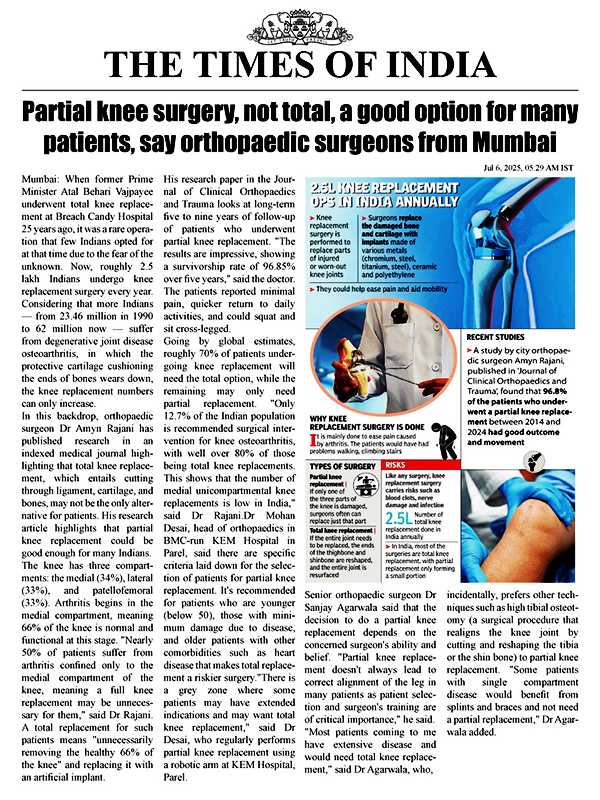
Dr Rajani’s 2025 research on Oxford cemented medial unicompartmental knee arthroplasty also reinforces why individual procedure type matters. In 191 knees from 180 patients, the team reported improvements in patient-reported outcomes and range of motion at five years, with 96.85% five-year implant survivorship in that study group. Those results relate to selected patients having partial knee replacement and should not be used as a promise for every knee replacement patient.
A Practical Checklist for Knee Replacement Recovery
During recovery after knee replacement surgery:
- Follow your personalised physiotherapy and walking programme.
- Increase activity gradually instead of jumping from rest to heavy exercise.
- Use walking aids for as long as your clinical team recommends.
- Follow wound-care instructions and watch for worsening redness, drainage, fever or unusual swelling.
- Take medicines only as prescribed.
- Keep your follow-up appointments.
- Ask before returning to driving, heavy work, high-impact sport or other demanding activity.
- Seek urgent medical advice for concerning wound or leg symptoms; seek emergency care for chest pain or difficulty breathing with signs of a possible clot.
The goal is safe, useful knee replacement recovery, not speed.
Frequently Asked Questions
What is the biggest mistake after knee replacement?
There is no single mistake for everyone, but ignoring the rehabilitation plan is a major problem. Both prolonged inactivity and excessive activity can interfere with knee replacement recovery.
How much should I walk after knee replacement surgery?
Walking usually starts early, but the amount should be personalised. Follow your surgeon or physiotherapist’s plan and increase distance gradually rather than chasing a fixed daily target.
Is swelling normal after knee replacement?
Some swelling is common during knee replacement recovery. Swelling that is worsening, accompanied by marked calf pain, wound drainage, fever, chest pain or breathlessness needs prompt medical assessment.
Can I skip physiotherapy if my knee feels good?
Do not stop prescribed knee rehabilitation simply because pain has improved. Strength, movement and gait still need to recover, so discuss any change to the programme with your physiotherapist or surgeon.
How long does knee replacement recovery take?
Basic function improves progressively, but full recovery may take several months or longer. The timeline varies with the operation, age, health, strength and rehabilitation progress.